

What to Sell When Affordability is the Objection
Affordability just became the defining objection in the under-65 market, and the old playbook for handling it doesn’t hold anymore. Agents who wait for clients to ask are already behind.
This piece walks through why the math changed, a better way to run the conversation than a straight plan pitch, and where a partner like Med Mutual Protect actually fits into the fix.
Here’s how to turn the hardest objection you’re hearing right now into the strongest part of your pitch.
Every agent working the under-65 market is hearing the same sentence right now, over and over: I can no longer afford health insurance. You heard it all through the 2026 open enrollment season. You are still hearing it during special enrollment. And for the first time in years, “let’s revisit at open enrollment” is not a good enough answer.
Here is why the ground shifted. For the last several years, enhanced premium tax credits meant that even clients above 400% of the federal poverty line could get help buying a marketplace plan. That help is gone. There used to be a glide path down from the subsidy cliff. Now there is just the cliff. A healthy client who was paying a manageable premium last year can open their renewal this year and find it has multiplied, with nothing to cushion the fall.
The result is millions of people leaving the marketplace. They are not leaving because they stopped needing coverage. They are leaving because they cannot afford what is in front of them, and many of them will resurface in May, June, and July suddenly realizing they need something. The agent who has an answer keeps those clients. The agent who does not will watch them find someone who does.
The mistake is ending the conversation too early
For years, the affordability objection had an easy escape hatch. If ACA did not work for someone, you moved on, because the pool was big enough that you did not need to solve the hard cases. That habit is now a liability.
The agents who will win the next few years are the ones who treat “I can’t afford it” as the start of a conversation, not the end of one. That requires two things: knowing that other solutions exist, and being willing to re-educate the client on what health coverage can look like. Most clients have only ever known one model, the copay-and-deductible major-medical plan. Showing them something structured differently takes a minute of teaching, but that teaching is exactly what makes an agent look like an expert instead of an order-taker.
Run a needs analysis, not a plan pitch
The best framing here comes from the exam room. When you go to the doctor, they do not glance at you and hand you Tylenol on the way out the door. They spend the first few minutes asking questions, figuring out what is actually going on. An agent should do the same.
A real needs analysis is what separates the expert from everyone else. Instead of assuming every client belongs on the same bronze plan, you ask: What do you need this coverage for? Is this a gap between jobs, or a long-term situation? How often did you actually use care over the last five years? Did you end up in the emergency room, and if so, what did it cost you? That last question matters, because the emergency room is the most expensive room a client will ever walk into, and their honest answer tells you how much catastrophic exposure they truly carry.
Once you understand the client’s utilization and their goals, the right direction becomes obvious. A high utilizer with a chronic condition may genuinely belong on an ACA plan, and part of being trustworthy is saying so. But a healthy client who rarely uses care should not be paying a fortune for a plan built for someone else’s risk. That is the client who has been overpaying for years, and that is the client an alternative solution was built for.
Where Med Mutual Protect fits
Med Mutual Protect is one of the alternative-coverage partners that makes this strategy work, and it fits the affordability conversation in two distinct ways.
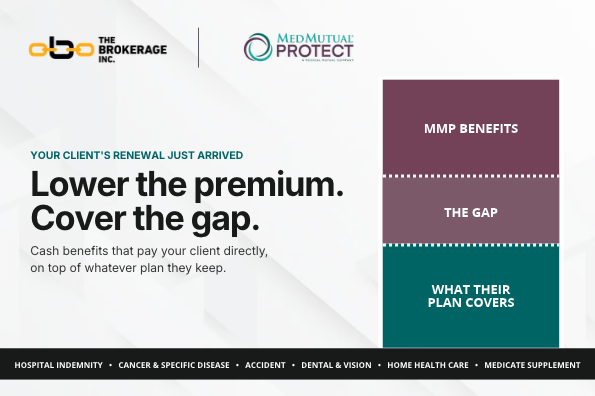
It can supplement an ACA plan. If a client keeps their marketplace coverage but is exposed on a large out-of-pocket maximum, MMP’s products can fill that specific gap so a serious claim does not become a financial disaster.
Or it can stand on its own, year-round, with no open-enrollment or special-enrollment window to wait for. For a client for whom the marketplace is simply unaffordable, you can build coverage from three independent products: a specified disease policy for the big internal threats like cancer, heart attack, and stroke; an accident policy; and a hospital indemnity plan that pays first-dollar benefits for everyday care. Because the products are sold a la carte, you are not forcing everyone into one rigid plan. You are matching coverage to what the person in front of you actually needs.
That last point is the heart of it. This gets back to what insurance was always supposed to be: protecting someone financially against the things they cannot absorb, rather than pre-paying for the small things they can.
The step-down method for the price objection
Sometimes even a well-matched full package lands a little high, and the client needs room to breathe. Because MMP’s three products are independent, you have a tool for that: the step-down method.
The counterintuitive move is to start high, not low. It is much harder to upsell from a cheap option than to step down from a fuller one. So you present the complete package first. If the client objects on price, you step down, peeling back to the coverage that protects them against the things they genuinely cannot afford to face, and letting them cash-pay the small stuff they can. You can even hand them a challenge: try covering the small visits out of pocket for a few months and see what it actually adds up to. Clients who take that challenge tend to come back agreeing with you. Something is always better than nothing, and a client protected against the catastrophic thing is far better served than a client who walked away with no coverage because the perfect plan cost too much.
Proof this works: from skeptic to believer
Consider a real example from the field. An agent who wrote almost exclusively ACA saw the writing on the wall but was deeply skeptical of alternative coverage. Three products, an a la carte structure, underwriting she had never dealt with: none of it made sense to her at first. She worked through the training anyway.
The moment it clicked was a claim. She had a client who had held a policy for only a couple of months when they tore up a knee badly playing softball. It was her first real claims experience with the carrier, and it was the test of everything she had been skeptical about. The client went through the MRIs, the surgery, and the physical therapy. When it was all said and done, because the products worked together, the client’s total out-of-pocket came to a small fraction of what a torn ACL would normally cost someone.
That is the whole argument in one story. The biggest objection agents carry into this space is the fear that the coverage will not be there when a client has something major. But because the core products are built on a deductible and co-insurance structure rather than fixed payouts alone, a large claim does not leave anyone wondering whether the benefit will reach far enough. The agent stopped being a skeptic the day she watched it work.
The window is open now
Three things are worth holding onto. First, affordability is not coming back; the enhanced subsidies are gone, and the smart move is to prepare for a market that looks permanently different. Second, the clients you have already lost on ACA are out there right now looking for a solution, and if you do not provide it, someone else will. Third, this requires an open mind about how health coverage can be sold and administered, because it does not work like the model everyone got comfortable with over the last five years.
Just offering ACA is no longer the way. The agents who educate themselves on alternative solutions are the ones who will keep their clients and grow while others shrink.
Get started
If you do not already have a contract with Med Mutual Protect, this is the moment to fix that. Get contracted through The Brokerage Inc. and attend one of our trainings, and you will walk away ready to turn the affordability objection into the strongest part of your pitch.
Reach out to The Brokerage to get contracted and get trained:
Register for the Webinar
Want to learn more? Register for the September 24, 2026 Med Mutual Protect webinar.