


CMS is ending the Part D Premium Stabilization Demonstration after 2026. Here is what that program was, what it has been doing quietly in the background of every quote you have run, and what actually changes for your first unbuffered AEP.
If your first Annual Enrollment Period was the one that ran in late 2024 for the 2025 plan year, or the one that ran in late 2025 for 2026, here is something worth sitting with for a minute.
Every standalone Part D plan you have ever quoted was priced inside a temporary federal program built specifically to keep premiums from moving the way they otherwise would have. You were not selling Part D. You were selling Part D with a safety net stretched underneath it.
That safety net comes off on December 31, 2026.
This is not a crisis, and it is not a reason to call your book in a panic. It is a reason to understand something your more tenured colleagues take for granted, and to understand it before October rather than during it.
What the program actually was
The Inflation Reduction Act rebuilt the Part D benefit starting in 2025. Four changes mattered most:
- A hard annual out-of-pocket maximum for beneficiaries, set at $2,000 in 2025, $2,100 in 2026, and $2,400 for 2027.
- A large increase in what plans themselves owe for catastrophic drug costs.
- A reduction in federal reinsurance, meaning the government picked up less of that tab.
- A new Manufacturer Discount Program replacing the old coverage gap discount structure.
Put together, that is a significant transfer of financial risk onto plan sponsors. CMS was concerned that plans facing that much new risk all at once would submit wildly different bids, that standalone Part D premiums would swing hard in both directions, and that beneficiaries would churn between plans chasing price rather than choosing on drug coverage.
So, in July 2024, alongside the preliminary 2025 bid information, CMS announced a voluntary demonstration for standalone prescription drug plans. It had three mechanisms, and it is worth knowing all three because they did different jobs:
- A uniform reduction to the base beneficiary premium used in calculating participating plans’ basic premiums. This is the piece most people mean when they call it a subsidy.
- A dollar limit on how much a participating plan could raise its total Part D premium from one year to the next. This was plan-specific, not a market average.
- Narrowed risk corridors, which meant CMS absorbed more of the downside if a plan’s costs came in worse than its bid.
It was voluntary, it was nationwide, and it applied to standalone PDPs. Not to Medicare Advantage prescription drug plans.
The wind-down, in three years
CMS never intended this to be permanent. It said at the outset the demonstration could run at least three years, and it began stepping the protection down after the first year.
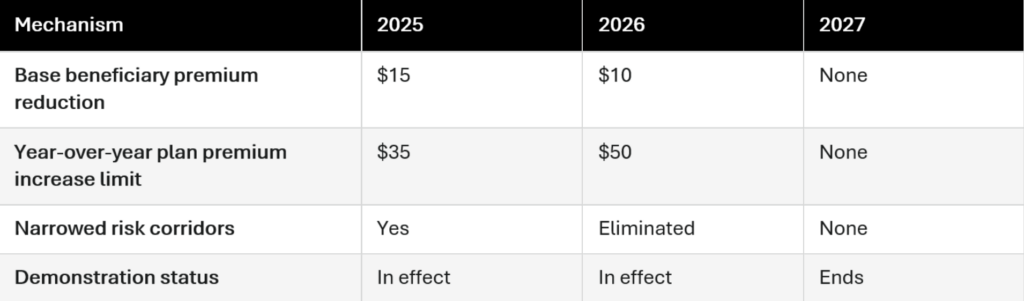
On July 28, 2026, CMS released preliminary 2027 Part D bid information and announced that the demonstration concludes at the end of 2026. The stated rationale was that CMS analysis of the submitted 2027 bids indicated plan sponsors now have enough experience under the redesigned benefit to price without it, returning the program to what CMS describes as traditional market conditions.
So the program is ending a year earlier than its original outside estimate. That is early, but it is not a reversal of what CMS said it was doing.
Four terms you need to know cold
This is the part that will separate you from the agents who repeat headlines. Three different numbers get thrown around in coverage of Part D, and only one of them is a premium. Learn the difference now.
National base beneficiary premium (BBP)
For 2027 it is $41.33, up from $38.99 in 2026 and $36.78 in 2025. This is the starting point in a statutory formula used to calculate a plan’s basic premium. It is not what your client pays.
The 6 percent cap
The Inflation Reduction Act limits annual growth in the national base beneficiary premium to 6 percent per year through 2029. The 2027 figure of $41.33 is precisely 6 percent above $38.99. This cap is separate from the demonstration and it is not going away. Critically, it applies to the national figure only. It is not a 6 percent ceiling on any individual plan’s premium.
National average monthly bid amount (NAMBA)
For 2027 it is $296.05, up from $239.27 in 2026. This is an enrollment-weighted average of all applicable Part D plan bids for the basic benefit, and CMS uses it to calculate the government subsidy paid to plans. Nobody pays this. No client will ever see it on a statement. If you take one thing from this article, take this: NAMBA is not a premium.
Plan-specific premium
This is the only number that ends up on your client’s Annual Notice of Change. It reflects that individual plan’s own bid, its supplemental benefits, the region, any rebates, and any low-income subsidy the beneficiary qualifies for. It is not published yet for 2027.
Careful: this is not Extra Help.
Say “the Part D subsidy is ending” in a room of agents and a good share of them will hear that the Low Income Subsidy is going away. It is not. LIS, also called Extra Help, is a separate statutory program and nothing in the July 28 announcement touches it. Use the full name, Part D Premium Stabilization Demonstration, on first reference before you shorten it. This is exactly the kind of confusion that travels from an agent to a client and then to a complaint.
Four things this announcement does not mean
It does not mean premiums are going up 24 percent
The national average bid went up roughly 24 percent. That is a wholesale figure used in a government subsidy calculation. Quoting it as a premium increase is the fastest way to be publicly wrong.
It does not mean premiums are capped at 6 percent
The 6 percent cap applies to the national base beneficiary premium. Individual plan premiums can move more than 6 percent, and the plan-level limit that used to constrain them is exactly what is being removed.
It does not mean Medicare Advantage is untouched
The demonstration applied only to standalone PDPs, which is true and gets repeated as though it settles the question. It does not. Part D economics feed MA-PD bids, and plans re-pricing for 2027 have decisions to make about supplemental benefits funded by rebates. Watch the benefit summaries on your MA-PD book, not just the premium line.
It does not mean anything is final
No plan-level 2027 premium is public yet. CMS releases the 2027 Medicare Advantage and Part D landscape, along with final average premiums, in mid to late September.
What to actually do between now and October 15
- Learn the vocabulary before a client asks. If you cannot explain the difference between the base beneficiary premium and a plan premium in one sentence, you are not ready for the question that is coming.
- Do not send a premium warning email. This is the one that matters. You do not have plan-level data. If you tell a client in August that their premium is going up and it does not, or it goes down, you have spent trust you will want in December. Wait for the landscape.
- Segment your book now. Pull three lists: standalone PDP clients, MA-PD clients, and anyone with LIS. Those are three different conversations, and the standalone PDP list is the one with the most exposure.
- Mark your calendar for mid to late September. That is when the landscape and final average premiums post. Annual Notice of Change letters mail in the fall. AEP runs October 15 through December 7.
- Plan to actually re-run every comparison. Two calm years can quietly train you to assume last year’s plan is still the right plan. In 2027 that assumption is the risk.
The honest bottom line
Here is the version to keep in your head, and the version to say out loud if someone asks:
2027 will be the first year since the Inflation Reduction Act redesign that standalone Part D plans price without additional CMS stabilization. CMS concluded plans now have the experience to do that under normal market conditions. What it means for any individual client is a September question, not an August one.
The agents who spend August learning the mechanics are the ones who will be able to answer calmly in October, while everyone else is forwarding headlines. That is the whole opportunity here, and it is available to you regardless of how long you have had your license.
This article is for licensed insurance professionals and is provided for educational purposes. It is not intended for distribution to Medicare beneficiaries. Figures reflect CMS information published as of August 5, 2026 and are subject to change. Plan-specific premiums and benefits for 2027 are not final until CMS publishes the 2027 landscape.